
Two numbers do most of the talking about context switching. One says that switching between tasks can cost "as much as 40 percent of someone's productive time". [2] The other says it takes 23 minutes to get back to what you were doing after an interruption. Both trace to real research. Neither figure means what the quote around it implies, and the gap is worth knowing if you are trying to work out whether a hundred open tabs is a real problem or just an untidy-looking one.
How much does switching between tasks actually cost?
There are two separate measurements and they are not the same number. In the lab, a single switch between two simple tasks costs somewhere between a few tenths of a second and about a second, and the cost grows as the tasks get more complex. [1] In the field, fully getting back to a task after an interruption took observed office workers an average of 25 minutes. [4] The lab figure is a tax on each switch. The field figure is the length of a detour, and it counts everything done in between.
The lab work is Rubinstein, Meyer and Evans, four experiments published in 2001. Participants alternated between classifying geometric shapes under changing rules, or solving arithmetic problems under changing operations. Every switch added time. The paper reports a representative switching cost of about 1,100 milliseconds for the arithmetic tasks, rising with rule complexity and falling when a visual cue announced which task was next. [1] The tasks themselves ran in seconds, so the cost is a transition measured against work measured in seconds.
The "40 percent" line is the APA's phrasing, not the paper's. Its summary of that research quotes David Meyer saying that "even brief mental blocks created by shifting between tasks can cost as much as 40 percent of someone's productive time". [2] That is one of the authors extrapolating from second-scale lab switches to a whole working day, in a press summary. It works as a rough ceiling for someone who switches constantly all day. It is not a measurement, and it appears nowhere in the study it is hung on. [1]

Where does the "23 minutes to refocus" figure come from?
It is a rounded, slightly wrong version of a number from a 2005 field study by Gloria Mark and colleagues at UC Irvine, who shadowed 24 information workers for more than 700 hours. When those workers were interrupted and returned to the task the same day, it took them an average of 25 minutes and 26 seconds. [4] The study was about workplace interruptions in general. It was not about browser tabs, and it did not isolate a "cost of switching".
The 25 minutes is not 25 minutes of staring at the screen trying to remember what you were doing. Before returning to the interrupted task, those workers handled an average of 2.26 other tasks. [4] The figure is elapsed time across a detour, not a fixed penalty you pay each time your attention moves. An earlier study by the same group is closer to the rhythm most people would recognise: workers spent about three minutes on any one activity, and about twelve minutes on a broader project or theme, before switching or being interrupted. [3]
One caveat the popular versions drop. This fieldwork was done before Slack, Teams and the current volume of desktop notifications. The direction of the finding is unlikely to have reversed since, but the specific minutes were measured in a different working environment, and anyone quoting them as current is quoting a 2005 office.
What actually happens when you switch: attention residue
When you move from one task to another, part of your attention stays behind on the first one. Sophie Leroy named this attention residue in a 2009 study, and showed that people perform measurably worse on a new task when the previous task was left unfinished. [5] Finishing the first task helps. Being under time pressure to finish it helps more, because the pressure is what forces you to actually let go of it.
Leroy's experiments used word puzzles, some allowed to finish and some interrupted, followed by an unrelated task. The residue was measured with a quick word-recognition test in between. The result that matters for a browser is the one about unfinished work: a task you did not complete is the one that leaves residue, and that residue drags on whatever you do next. [5] A task you closed off cleanly does not follow you in the same way.
Do browser tabs cause context switching, or just display it?
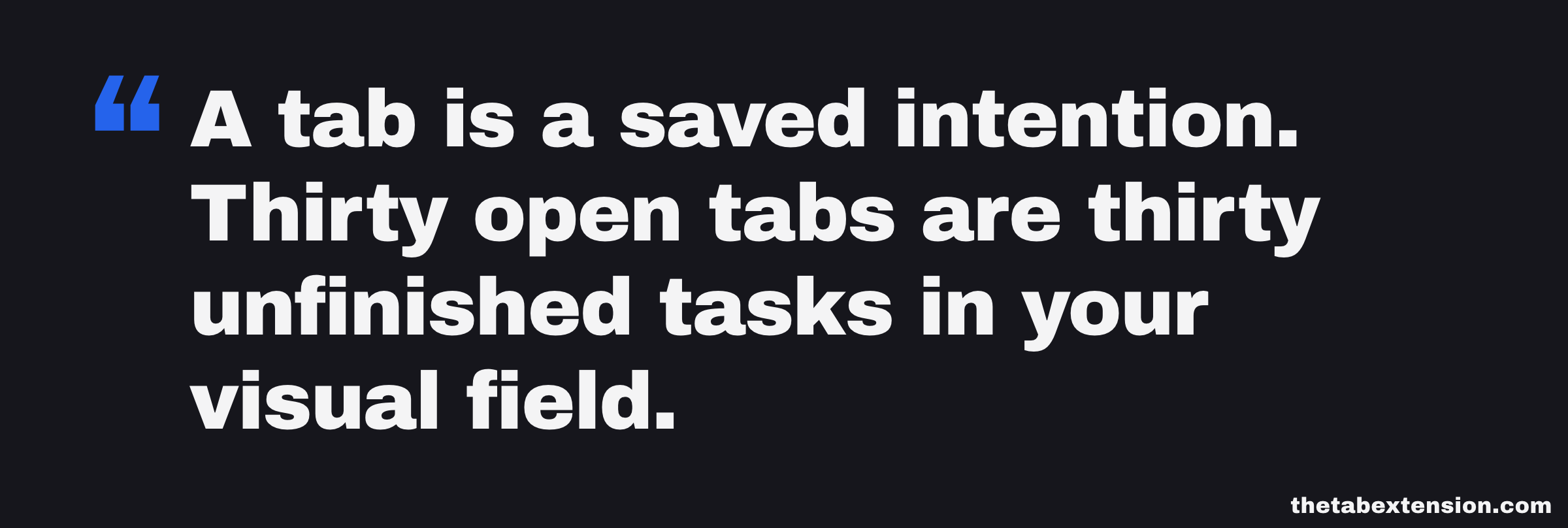
A tab is a saved intention. It is a task you meant to get back to, held open so you would not forget. Thirty open tabs are thirty unfinished tasks in your visual field, each one a small piece of attention residue and a standing candidate for your next unplanned switch. Closing tabs does not remove the cost of the switches you deliberately choose to make. It removes the ones you make because you glanced up and saw the tab.
The Mark study has a detail that reads like it was written about a tab strip. Workers reorient fastest when there is a precise cue waiting for them, "a blinking cursor at the end of the last typed word"; they struggle when "other windows have been opened" and they cannot remember which document they were even in. [4] A row of tabs is the second situation by design. It shows you many entry points at once and gives no sign of which one you left, or why.
None of this research says a tidy browser makes you focus. Switch cost is cognitive, and you pay it on every switch regardless of how the tabs are arranged. [1] What an open pile of tabs changes is the number of switches you never planned, and the residue you carry from tasks you can still see. That is a smaller claim than "clean your tabs and concentrate", and it is the one the evidence supports.
What reduces the cost
Three things the research points at, in rough order of how much they help.
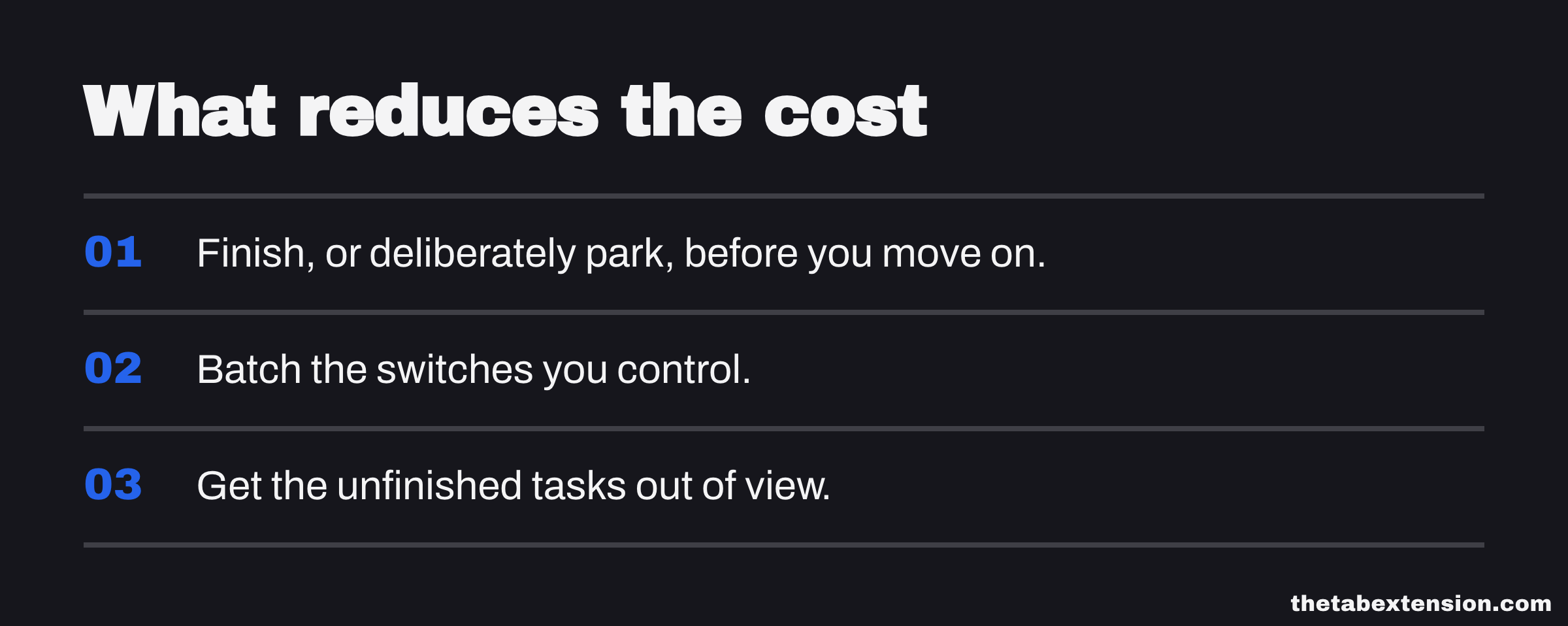
Finish, or deliberately park, before you move on. Leroy's finding is that the unfinished task is the one that follows you into the next one. [5] When you genuinely cannot finish, the next best thing is to write down where you stopped and close it, so that reopening it later is a decision you make rather than a reflex triggered by seeing the tab. This is the one with the most evidence behind it and the one most people skip.
Batch the switches you control. The lab cost is charged per switch. [1] Handling messages in three blocks instead of forty interruptions is the same work with a fraction of the transitions, and the transitions are the part you were paying for.
Get the unfinished tasks out of view. A saved and closed set carries no residue and prompts no unplanned switch, because you cannot see it to be pulled back to it.
Saving every open tab in one action and closing the window is the workflow TheTab is built around, and what it leaves behind is a dated list rather than a strip of live entry points. The property doing the work is "out of sight in one move", not our particular version of it; the four kinds of tab manager covers the whole field, and the loss aversion that makes closing a tab feel expensive is why the single move matters more than it sounds. If the tabs are costing you memory as well as attention, note that closing them frees RAM only when the whole process closes, which is a separate problem with a separate answer.
What to expect
Context switching has a real cost, and it is not one number. It is a fraction of a second to about a second on each switch you choose to make, a longer detour when something interrupts you, and a background drag from every unfinished task still sitting in view. Browser tabs land on the third of those. A shorter tab strip will not hand you your concentration back, but it does remove a source of switches you never decided to make, and that is the part worth acting on.
SOURCES
Every factual claim in this article traces to a source below. Where we could not source a claim, we removed it rather than softening it.
Rubinstein, Meyer and Evans, volume 27 number 4, pages 763 to 797, DOI 10.1037/0096-1523.27.4.763. Four experiments in which participants alternated between classifying geometric objects under different rules or solving arithmetic problems under different operations. "Task alternation yielded switching-time costs that increased with rule complexity but decreased with task cuing"; the effects were additive, supporting a model with goal-shifting and rule-activation stages. A representative switching-time cost in the arithmetic experiments was "approximately the same 1,100-ms". The paper reports no figure for a percentage of a working day; its only percentages are error rates of four to nine percent.
The APA's own summary of the Rubinstein, Meyer and Evans research. It states that the experiments had participants switch "between different tasks - such as solving math problems or classifying geometric objects", that time costs were "a few tenths of a second" and grew with task complexity, and it quotes Meyer: "even brief mental blocks created by shifting between tasks can cost as much as 40 percent of someone's productive time." Read 10 September 2026, dated with the read date because the APA revises this page in place.
Gonzalez and Mark, pages 113 to 120. Fieldwork with information workers in three roles. "People average about three minutes on a task and somewhat more than two minutes using any electronic tool or paper document before switching tasks." Workers "worked in an average of ten different working spheres", and spent "about 12 minutes in a working sphere before they switch to another" (eleven and a half minutes of continuous work on a project or theme).
Mark, Gonzalez and Harris, pages 321 to 330. Detailed observation of 24 information workers over more than 700 formal hours. Working-sphere segments averaged "11 min. 4 sec." before a switch or interruption; "57.1% of all informants' working sphere segments were interrupted"; "77.2% of interrupted work was resumed on the same day". "When people did resume work on the same day, it took an average length of time of 25 min. 26 sec", and "before resuming work, our informants worked in an average of 2.26 working spheres". The paper notes that "a blinking cursor at the end of the last typed word can enable one to immediately reorient to that document, whereas if other windows have been opened, it can be hard to remember even which document had been worked on."
Leroy, volume 109 number 2, pages 168 to 181. Introduces "attention residue". Two experiments: "people need to stop thinking about one task in order to fully transition their attention and perform well on another", "it is difficult for people to transition their attention away from an unfinished task and their subsequent task performance suffers", and "being able to finish one task before switching to another is, however, not enough ... Time pressure while finishing a prior task is needed to disengage from the first task".